Pressure Compensating Drip Tape: Why Flow Stays at 2.0 L/H When Terrain Does Not Stay Flat
Published
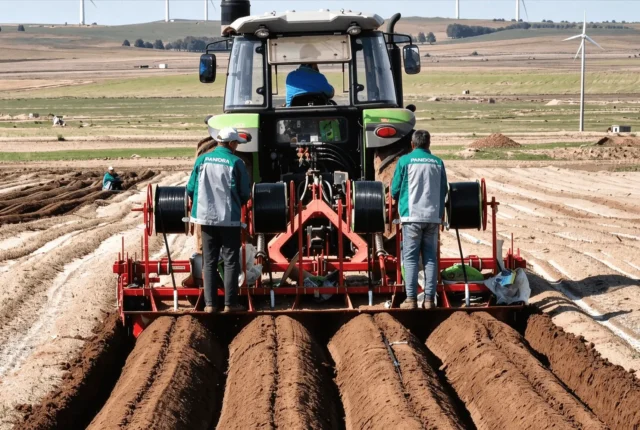
A chili farmer we worked with ran 90-meter laterals across ground that dropped about five meters from the pump side to the far end. On ordinary drip tape, the bottom rows stayed wet and the top rows went dry — same tape, same pump, same fertilizer. The tape was not broken. It was obeying physics: emitter flow rises and falls with pressure. Pressure compensating drip tape exists to break that relationship, holding outlet flow near 2.0 L/h whether the emitter sits high or low on the line.
Here is what happens inside the emitter, where it helps, and what to check before ordering a container.
What Pressure Compensation Actually Fixes
In a non-compensating emitter, flow changes with the square root of pressure. Double it and flow rises about 41 percent — not 100, but far from nothing.
Put numbers on it. Water pressure rises roughly 0.01 MPa for every meter of elevation drop — about 1.45 PSI. On that 5-meter chili slope, low-end emitters see about 0.05 MPa more pressure than high-end ones:
- If the line is set at 0.10 MPa: low-end emitters run near 0.15 MPa, flow about 22% over spec — over-watering, deep percolation, wasted fertilizer.
- The high end runs near 0.05 MPa, flow about 29% under spec — the dry rows the farmer walks past every morning.
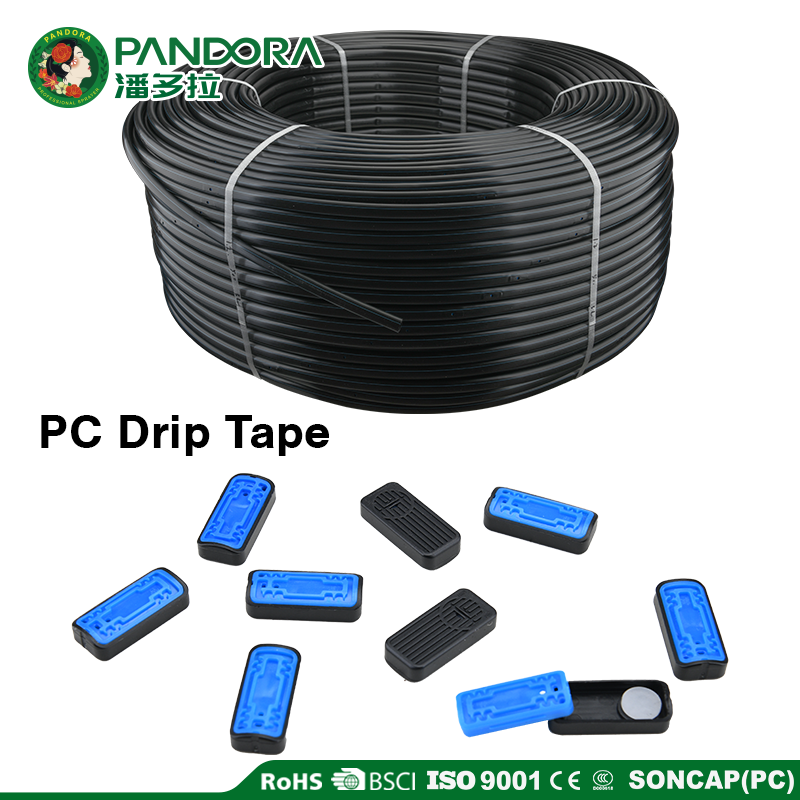
A pressure compensating emitter closes this gap with a silicone diaphragm. As inlet pressure rises, the diaphragm compresses and narrows the labyrinth flow path; as pressure falls, it relaxes. Inside the compensation window, outlet flow barely moves. That is why the same tape can run up a terrace edge without the top of the row starving.
PC vs Non-PC at a Glance
| Factor | Non-PC | PC |
|---|---|---|
| Flow vs pressure | Follows √P, varies with terrain | Near constant in compensation window |
| Uneven terrain | Top rows under-watered | Uniform along the line |
| Lateral run length | Short runs only | Long runs stay within spec |
| Compensation range | Not applicable | Roughly 0.05–0.30 MPa |
| Filtration demand | Standard | Slightly higher (precision diaphragm) |
| Cost per meter | Lower | Higher, paid back in water and yield |
Inside the Emitter: Where Quality Is Actually Decided
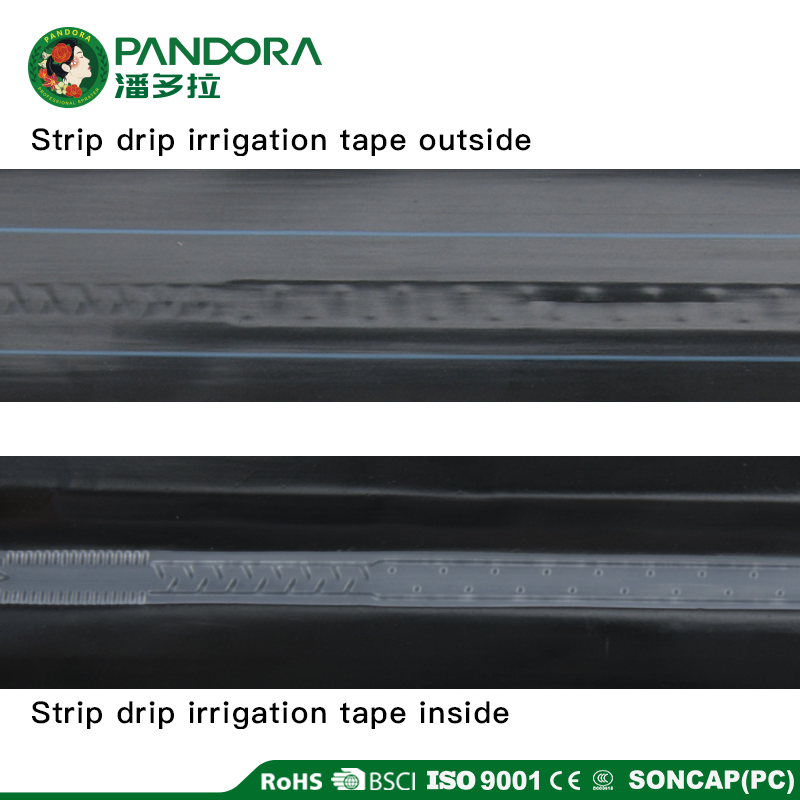
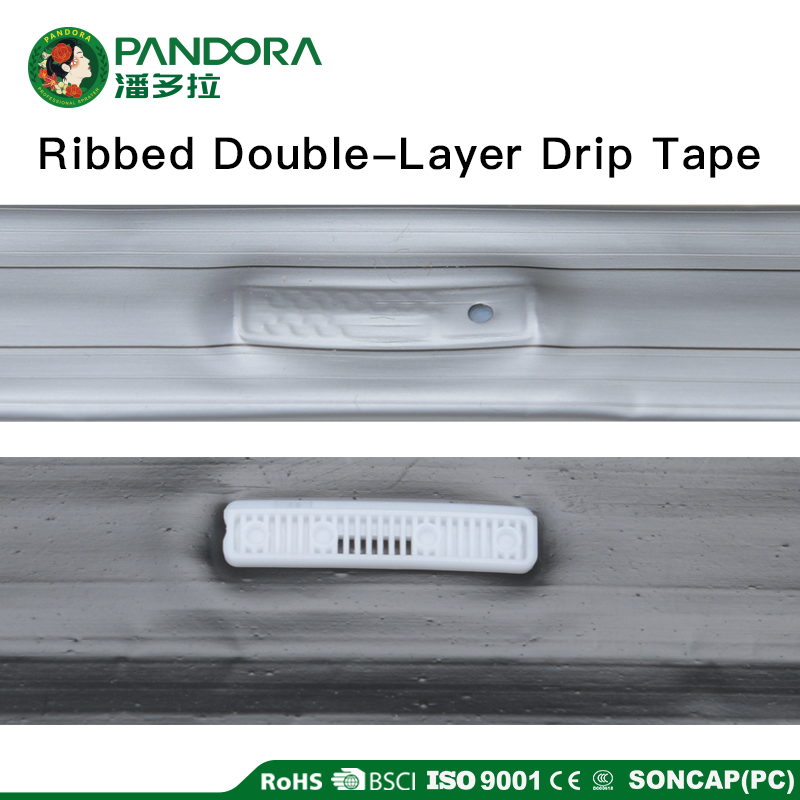
The emitter in our pressure compensating drip tape is a separate injection-molded part — plastic labyrinth plus silicone diaphragm — fused into the tape during extrusion. Three manufacturing details separate an emitter that lasts seasons from one that fails mid-season:
- Labyrinth channel tolerance. Compensation depends on channel depth staying within tight limits. A mold worn by a few hundredths of a millimeter shifts the pressure-flow curve of every emitter it produces. We check cavity dimensions on a fixed schedule — a drifted mold shows up in the field as “tape that compensates unevenly,” a fault no farmer can diagnose.
- Weld integrity. The emitter is fused into the tape wall, not glued. A weak weld peels under soil movement or thermal expansion, and water bypasses the labyrinth entirely — the emitter reads 2.0 L/h on the bench and 6 L/h in the ground. Peel testing is part of our line QC, not an optional lab exercise.
- Manufacturing variation. Emitter-to-emitter variation is a factory property, not a field condition. The USDA Natural Resources Conservation Service sets the bar in its Microirrigation practice standard: point-source emitters should show a coefficient of variation (CV) below 0.05, line-source emitters below 0.07. Ask any supplier for the CV report of the actual production batch, not a brochure.
Pressure compensating drip tape holds emitter flow near constant across roughly 0.05–0.30 MPa because a silicone diaphragm inside each emitter narrows the labyrinth flow path as pressure rises — cancelling the square-root-of-pressure relationship that makes ordinary drip tape over-water low ground and under-water high ground.
Choosing Wall Thickness
Wall thickness is a service-life decision, not a comfort one. The diaphragm handles pressure differences; the wall handles dragging, sun, soil and machinery.
| Wall | Typical service pattern | Field notes |
|---|---|---|
| 0.6 mm | One-season vegetables, recovered after harvest | Lowest cost per season; handle carefully during retrieval |
| 0.8 mm | Single season with mechanical laying | Better tear resistance during installation |
| 1.0 mm | Two to three seasons on the same land | Common for strawberry and vegetable rotation |
| 1.1 mm | Multi-season row crops | Balances cost and durability |
| 1.2 mm | Perennial rows, orchard alleys | Withstands more traffic |
| 1.5 mm | Buried lines, long runs, rocky ground | Highest puncture resistance |
Spacing follows the crop, not the catalog: 20–30 cm for strawberry beds, 30–40 cm for tomato and chili rows, wider for orchard trees. Every combination carries the same 2.0 L/h emitter, and the full wall and spacing matrix sits on the 16 mm pressure compensating drip tape specification page.
What PC Tape Asks in Return: Filtration
Honesty helps here more than marketing. The compensation diaphragm sits in a chamber with clearances measured in fractions of a millimeter. Sand, algal floc and undissolved fertilizer crystals that a non-PC labyrinth might flush through can lodge there — and a lodged diaphragm stops compensating.
Practical requirement: roughly 120-mesh (about 125 micron) filtration before the laterals, plus periodic flushing. NRCS guidance already lists water testing, filtration and flushing as baseline operation for any emitter system — PC tape turns that recommendation into a requirement.
Crop Scenarios
Chili on uneven ground. Chili is often planted on small plots with natural fall, exactly where line-source pressure differences appear. Pressure compensation removes the “wet bottom, dry top” pattern and evens out fruit set along the row.
Tomato seedling production. In seedling trays and nursery beds, each cell must receive the same water and fertilizer dose. Uniform emitter output is what keeps a house of seedlings even in height and stem diameter.
Strawberry beds. Raised-bed drip reduces leaf-canopy humidity, which lowers fungal pressure and the spray cycles that follow. Compensation matters on the longer beds used in commercial production.
Emerging-market orchards. Mango and coffee rows on sloped or terraced ground face the same physics as the chili field — elevation change along every lateral. PC tape is often the difference between one uniform irrigation block and several mismatched ones. The FAO notes agriculture accounts for 72 percent of global freshwater withdrawals; uniform emitter flow is where irrigation modernization actually touches the field.
Ordering for a season, not a sample
A container of drip tape that compensates unevenly is not a discount — it is a replanting bill. We supply PC drip tape with batch CV reports, weld peel-test records and a written compensation-range specification, so what you ordered is what arrives.
→ Request the batch QC report and full specification sheet
Before You Order a Container
Three checks take an afternoon and prevent a season of claims:
- Bench flow test across pressures. Run sample tape at 0.05, 0.15 and 0.30 MPa with a bucket and a stopwatch. A true PC emitter stays near 2.0 L/h at all three; a fake one swings with the pressure curve. One-minute volume should stay within about ±5% of the rated rate.
- CV documentation. Ask for the coefficient of variation of the production batch against the NRCS line-source benchmark of 0.07. The number exists or it does not.
- Weld peel sample. Cut an emitter section from sample tape and try to peel it. A proper weld tears the tape wall before the joint lets go.
FAQ
Q: Does pressure compensating tape work at very low pressure?
Below the lower edge of the compensation window — around 0.05 MPa for this tape — the diaphragm is fully relaxed and the emitter behaves like a non-PC one: flow falls with pressure. Design inlet pressure to sit inside the window rather than at its edge, especially on long runs with elevation loss.
Q: Can pressure compensating tape be buried?
Yes — the 1.5 mm wall version is intended for subsurface use. Burial adds root-intrusion to the clogging list, so filtration and flushing matter more, and rodent protection should be assessed for the site.
Where to Go From Here
If your fields — or your customers’ — include slopes, terraces or laterals over 60 meters, ask for a test roll with the matching compensation-range spec sheet. Run it against whatever you use now, at three pressures, one afternoon. The numbers will make the decision.
View the pressure compensating drip tape specification and request a sample roll
Turn Insight Into Action
Need product recommendations for your market?
Share your target crop, product category, order quantity, packaging needs, and OEM/ODM goals. PANDORA can help prepare a practical sourcing route.